Test every plan against thousands of futures.

Red pin: share of futures with a critical shortfall at that brigade.
Demonstration scenario. Fictional data. Map data © OpenStreetMap contributors
| Brigade | As planned | With added lift |
|---|---|---|
| Brigade A | 32% | 11% |
| Brigade B | 25% | 7% |

| Brigade | Days on hand | Futures short today |
|---|---|---|
| Šiauliai | 0 days | |
| Rukla | 0 days | |
| Pabradė | 0 days | |
| Brigade A | 1.1 days | 19% |
| Brigade B | 1.2 days | 14% |
A rail line closes for ten days.
Stocks at the forward sites run down, and the brigades are at their lowest days after the line reopens. The red figure at each brigade is the share of 2,000 futures in which it is short that day.
37%
chance of a critical shortfall, as planned
15%
with the first-ranked option
Each course of action runs through 2,000 simulated futures, with closures, weather, cyber incidents and damage to a site or route.

The planner at work, from a question to the released plan: the courses of action ranked, the days on the map, two approvals and the audit chain verified.

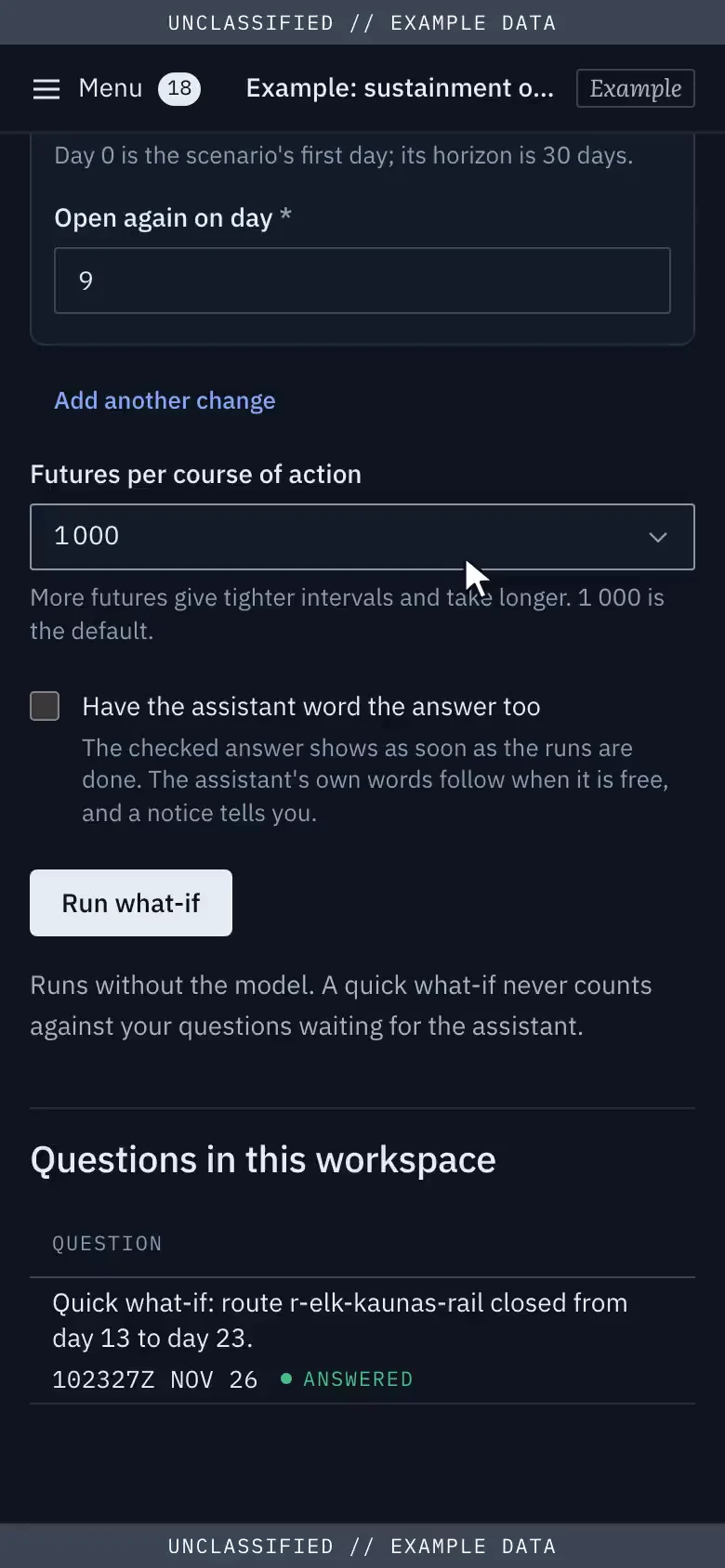
The planner asks
What if the rail route from Ełk to Kaunas is closed from day 13 to day 23?
The assistant answers
In numbers, and each one names the run it comes from.
A release takes two people.
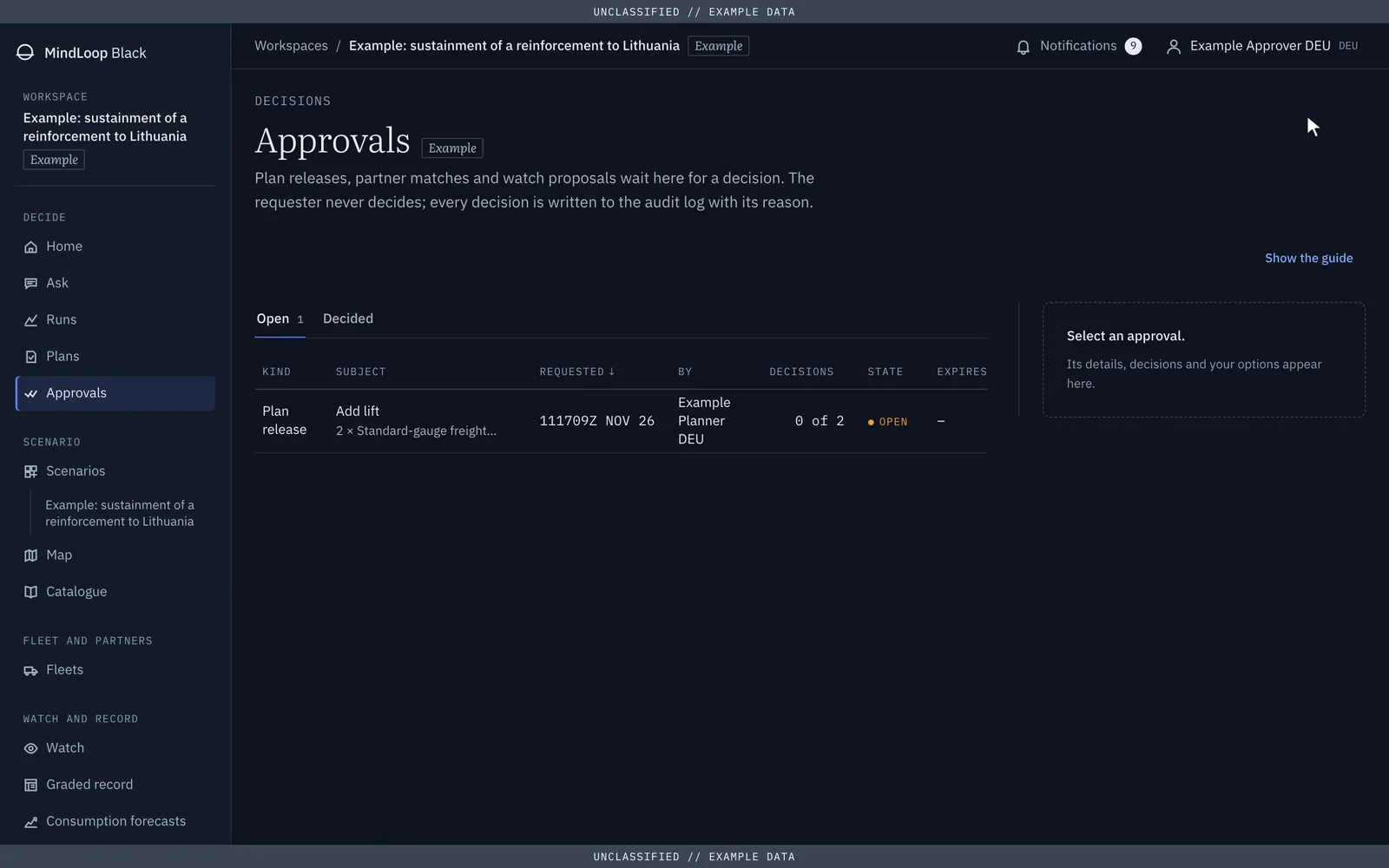
Two people approve a plan release, one after the other, each with a stated reason. The person who asked for it never decides, and every decision goes into the audit trail.
The whole platform
Decide
- SimulationAn operation's network across thousands of futures, with closures, weather, cyber incidents and damage to a site or route.
- Courses of actionGenerated, ranked and compared on the same futures.
- Plan editorAdjusts an option before it is adopted.
- Planner assistantAnswers in English, German and French, and asks back when a question is unclear.
Ready and sustain
- Always-on watchRe-runs the plan on a schedule and brings options that are ready to approve.
- Fleet readinessAvailability, maintenance, batteries and parts for UAS and any fleet of vehicles, aircraft or vessels.
- Digital twinsUnits, sites and fleets stay in step with every import. Forecasts are graded against what happened.
- Any unit, any equipmentAdded as data, with its APP-6 symbol on the shared map.
- BriefingsEvery run as PPTX and PDF.
Fits what you run
- Imports SAP-format data and a LOGFAS mapping.
- Messages APP-11 message formats.
- Shared picture NVG export and APP-6 symbols.
- Exercises C2SIM and HLA links.
- Federation An FMN conformity self-check.
- Coalition exchange Nations share capacity. Releasability labels travel with the data, both sides approve, and the exchange keeps working over disconnected links.
It runs inside your network.
- On premises
- One signed offline bundle installs on your own Kubernetes cluster.
- Air-gapped
- It runs with no connection to the outside.
- Models
- The planner assistant runs on open-weight models inside your network.
- Sign-in
- Smart card, with roles for planner, approver, commander, auditor and administrator.
- Labels
- NATO security labels and need-to-know on every row.
- Audit
- Tamper-evident and hash-chained, forwarded to your SIEM.